How one user question becomes several search queries
Published: · Reviewed by the geo-rank.ai editorial team · Our methodology
A user asks one complex question, but answering it may require evidence from several sources. A service with web search can break the task into related questions and search for them separately. This approach is called query fan-out.
For an article writer, the useful question is which part of the decision the material helps verify. A detailed export guide may support an answer about choosing software even if its heading does not repeat the buyer’s entire question.
Google confirms that AI Mode and AI Overviews may use query fan-out to run related searches across subtopics and data sources. Its documentation does not specify a universal number. “One question becomes dozens of searches” is therefore a possible scale, not a rule for every answer. Google Search Central.
A question can contain several selection conditions
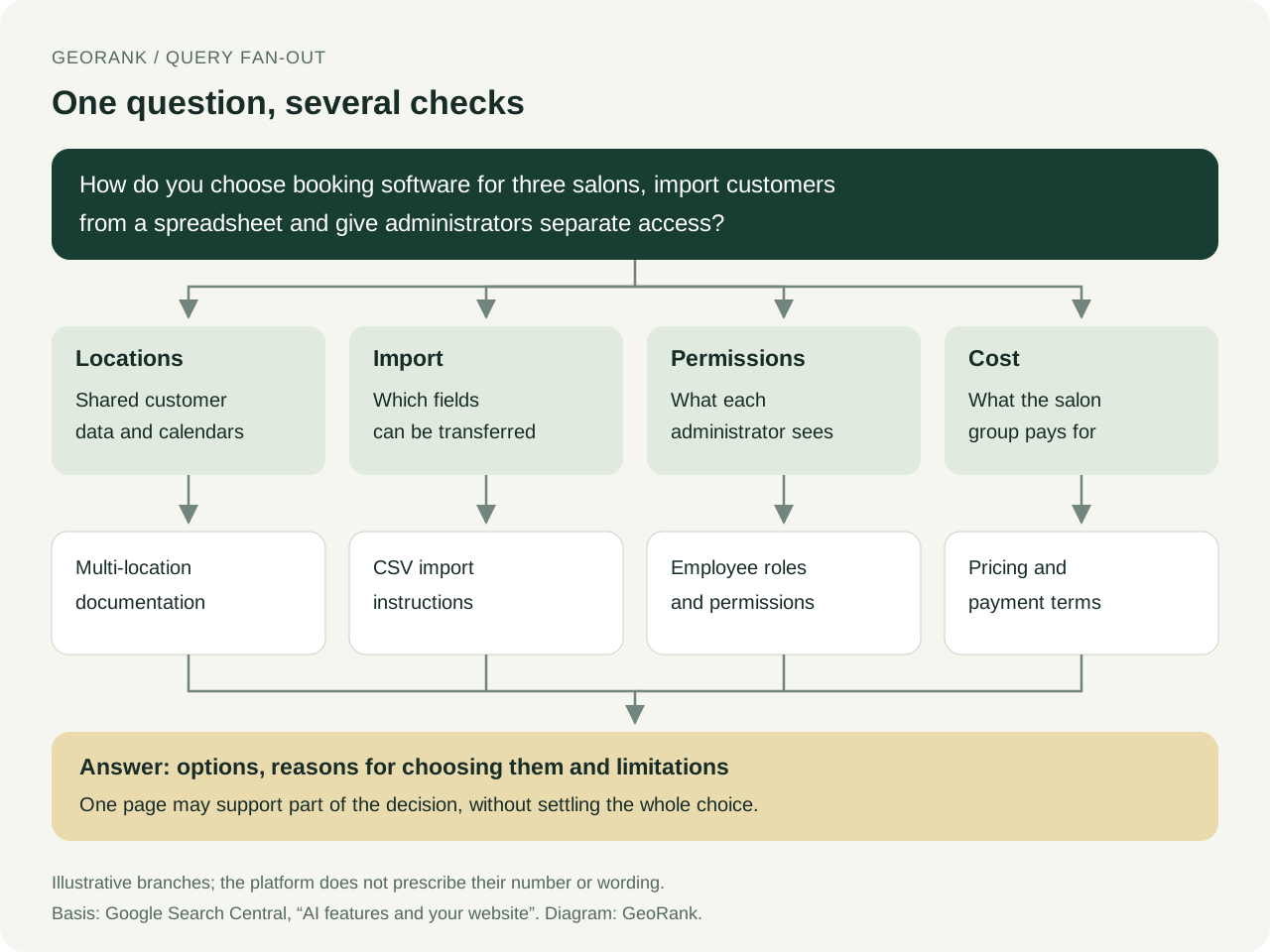
Consider this illustrative request: “How do I choose a booking service for three salons, migrate customers from a spreadsheet and give reception staff separate access permissions?”
A useful answer needs to check at least four conditions: multiple locations, import capabilities, staff permissions and the cost of the configuration. A generic list of popular services is insufficient.
Scroll horizontally to see all columns.
| Part of the task | Possible follow-up search | Material that could verify the condition |
|---|---|---|
| Three salons | Booking system shared customer database across locations | Multi-location and shared-database documentation |
| Spreadsheet migration | CSV customer import fields and restrictions | Import instructions and a sample file |
| Staff access | Staff permissions for customers and schedules | Roles and permitted actions |
| Configuration cost | Booking service pricing for three locations and extra staff | Pricing with clear billing units |
These are possible research directions, not queries the service must run. It might combine conditions, ask for clarification or fail to find sufficient evidence.
What actually branches out
Distinguish rewriting the original question, searching across subtopics and conducting additional searches after reviewing initial results. They can occur together without implying an identical sequence across platforms.
OpenAI describes ChatGPT rewriting questions into one or more targeted queries when using search partners, with further searches where needed. This establishes the possibility of multiple steps, not the exact queries behind a particular answer. ChatGPT Search documentation.
iPullRank’s query fan-out chapter offers a detailed way of thinking about subtopics and selection conditions. It can inform an editorial map. Its proposed internal stages and search routes should not be treated as a published technical specification for every service.
A branch does not automatically need its own article
A question map reveals gaps; it does not determine the page count. Conditions that buyers check together often belong in one article. A standalone procedure may deserve a separate URL.
A salon-chain overview can briefly cover locations, roles and cost. An import guide with a sample file, troubleshooting and result checks has its own purpose. The overview should link clearly to it.
Five near-identical pages for two, three, four, five and six salons are not useful merely because the number changes. Separate pages make sense when scale materially changes architecture, pricing or implementation and the differences can be explained.
Design content around a decision
Extract constraints from real customer questions: the existing database, location count, staff permissions and acceptable migration time. Separate known needs from assumptions. Do not expand an article around accounting integrations solely to add another speculative branch if customers have not raised that issue.
For each condition, write a verifiable answer and identify its evidence. “Import available” leaves much unclear. “Names and phone numbers are imported; visit history requires a separate process” helps buyers assess fit—if those are the product’s actual capabilities.
Distribute the information across existing pages. The overview helps compare options, pricing explains the calculation and instructions explain execution. Check whether an existing page already addresses the task before adding a URL.
Scroll horizontally to see all columns.
| Buyer question | Content for the overview | Detailed destination |
|---|---|---|
| Is the customer database shared across locations? | The shared-database conditions and material limits | Location documentation |
| Which records can be migrated? | Supported data types | Complete import guide |
| What can a receptionist see? | A short role comparison | Permissions documentation |
| How are chain-wide costs calculated? | A calculation with explicit assumptions | Current pricing |
This structure primarily helps buyers. Its effect on AI source selection remains a hypothesis until measured under comparable conditions.
Check whether a fragment stands on its own
An answer may use only part of a page. Keep material conditions next to the claim they qualify.
Compare these fictional fragments:
“We migrate everything in one day. Ask your account manager for details.”
“Standard CSV import transfers customer names and phone numbers. Visit-history migration is assessed separately; timing depends on the source-data format.”
The second explains the boundaries without unverifiable promises. It is not a mandatory length template or a guaranteed citation technique. The test is whether someone can read the paragraph alone and understand exactly what it claims.
Apply the same check to tables. Prices need billing units and inclusions. Features need a plan or version where relevant. Illustrative data must be labeled.
What a completed answer cannot reveal
Six sources do not prove six searches. One search can yield several relevant pages; several searches can lead to the same page. Citations also do not expose every source considered and rejected.
Asking the model to show its searches does not turn its next explanation into a reliable technical log. To study internal actions, use actual available tool or interface records and document their limits. Without those, describe only the visible answer and links.
Start with one recurring buying question
Break it into conditions, locate the existing pages that answer them and identify one important gap. Expand the appropriate page or write a separate procedure when the task warrants it.
Then compare answers to the original question and its individual conditions. Check whether relevant sources appear and whether limits are described correctly. Success is not the number of new pages; it is whether buyers can verify what matters to their choice. See our broader guide to AI source selection.